When I was studying Hebrew in a classroom, we sometimes listened to songs as a different way of practicing our new vocabulary. One of the more whimsical choices was a song called “Rutzi, Shmulik,” all about a girl who was deeply infatuated with a chap called Shmulik. How this was a romantic name, I just don’t know. But when her friends said, “Rutzi (come a-running, girl), Smulik’s calling you,” well, of course she came! I imagine that most of us have someone in our lives for whom we would drop everything, at a simple call. That’s the power of love.
Hebrew (and especially Biblical Hebrew) is an incredibly compact language. Sometimes just one word encompasses two or three, and maybe even four English words. Take the latter part of Isaiah 6:8. In English it’s, “Here am I; send me.” In Hebrew, it’s simply hineni; shalecheni.
Take the word kumi. It means “arise!” but encoded within it is the intended recipient: a woman, or a girl.
It’s a commanding word; a tender word.
“Arise! Come, my love,” Solomon calls to his bride. Kumi! Lechi, rayti.
Jesus used it to raise a twelve-year-old girl from her death-sleep: “Get up, little girl!” Talitha, kumi!
Peter must have used it too, in reviving Tabitha/Dorcas, the gentle woman whose name meant “gazelle.” Kumi, Tabitha.
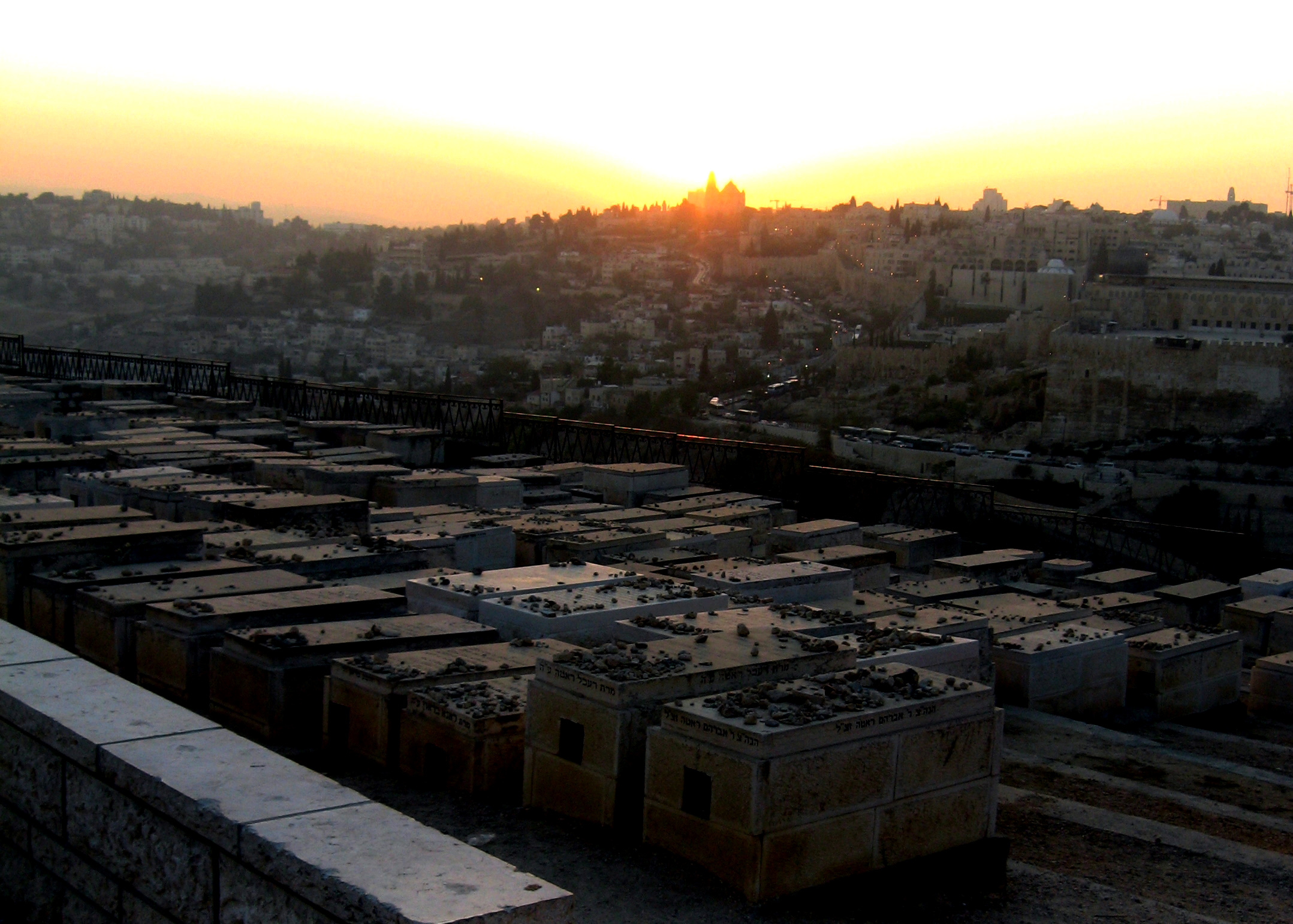 There are many graves in Jerusalem. Whether due to millennia of burials there, or the promise of Messiah’s coming to the area, thousands of them cover the Mount of Olives alone. Recently, I visited a much more obscure spot, a little Protestant graveyard tucked behind a wall in the heart of modern Jerusalem. I usually find the story-filled atmosphere of a cemetery to be fascinating, thought-provoking, meditative; this time I came away with one particular gravestone firmly lodged in my memory. It belonged to a woman called Ori, whose name means “shine!”
Beneath her name was written the first part of Isaiah 60:1:
“Kumi, ori, ki ba orech.” — “Arise, shine, for your light is come.”
Jesus made it clear that resurrection is not an event; it’s a Person. Who is personally connected to us. I can’t helping think that whoever had that stone engraved was reading the verse like this: “Arise, Ori, for your Light is come!”
Because when Ori’s Savior arrives and speaks her name, nothing (no, not even death!) will keep her from answering that call.
There is no more irresistible power than Love Himself. And oh, He is calling to the dead places in my life today. So those dry bones (no matter how dry they are) won’t be able to help themselves. They’ll just have to arise and live.
For Him.


 Elisabeth Adams