
As if nothing was wrong, my mother bustled into the room, directing my brother-in-law to replace the brazier with a low table, and enlisting my help with the serving. While the older women carried food to the men, I presided over the children in the kitchen, doling out the flat loaves, which they used like spoons to scoop lentils from the communal pot. I snatched bites from time to time, but my mind was outside with my father and brother, and with Miryam, who so desperately needed a place to rest.
Clearing the table in front of the men, who had subsided into disgruntled silence, I saw that my uncle Micah had risen and was staring toward the front door in disbelief.
Turning, I saw my father, eyes blazing with some unreadable, overwhelming emotion, pulling the door open wide as he entered. And allowing Yosi to carry Miryam inside.
Everyone froze.
Everyone except my mother. After one look, she took charge. “Lydia, get some clean rags! Sarah, heat some water. Hava, bring the children downstairs: we’ll need the upper room.”
The upper room? I made a swift decision of my own. Pushing my way through the knot of women, I said quietly, “No, mother, the guest room is too full! Let Miryam have Nathan’s spot: he won’t mind.”
She looked at me keenly, and then nodded. Turning to Yosi, she said, “You can take her downstairs where there’ll be more privacy.”
Uncle Micah approached my father and laid a heavy hand on his older brother’s arm. “What is going on?” he demanded.
My father did not appear to have heard. He seated himself in his chair, and the men again gathered around him. After unrolling a yellowing scroll on the table’s scarred wooden surface, my father beckoned me to join them. As I knelt on the floor beside him, I saw that it was our family’s generation-book, one of our most valuable possessions. It formed an important part of each marriage negotiation – as it did for every Jewish family, but especially for ours. Because of our ancient heritage, it was my father’s ambition to marry each of his children to another member of the poor, obscure, but still honored house of David.
“Look, Hava,” my father said, pointing at the oldest entries. “Here it says, ‘Judah was the father of Perez and Zerah by Tamar.’ And do you know who Tamar was?”
I pursed my lips and pretended to think deeply, recognizing a game I’d been familiar with since my childhood. Every father teaches his children by asking questions, and as the youngest, I had come in for more than my share.
“Tamar,” I said deliberately, “was Judah’s daughter-in-law.”
My father nodded. “And who was Rahab, the mother of Boaz and grandmother of our beloved king David?”
My little cousin Daniel let out a small sigh and vibrated with excitement. Obviously, he knew the answer, but my father kept his eyes fixed on me.
“Rahab was a prostitute and a Canaanite,” I replied.
“And who,” my father growled, “was the wife of Boaz and king David’s own mother?”
“A Moabite daughter of pagans,” I answered. “Her name was Ruth.”
Suddenly my father became animated. With a flourish, he ran his finger down the list of names on the scroll, stopping at last on his own. “And who is the daughter of such an august line?” he asked, his eyes twinkling.
“I am,” I said.
“Daughter of David,” he demanded gaily, “Do you suppose that God was wise to choose a king whose mothers were dishonorable women?”
Now I understood. Looking straight at Yosi, who waited uneasily by the door, I said, “God is so wise that He looks at the heart, not the appearance.”
“Well done,” my father replied.
My uncle Abner shifted uneasily in his chair, his face now red with embarrassment. “So you accept the woman and her child into our family?”
“Precisely,” my father replied. “And if we, the elders, do nothing to fuel the fire, the rumors will soon die down.”
He glanced at the window: it was dusk, and time for evening prayers. “Now, Yosi,” he said simply.
In a clear baritone, my brother began to sing: “Hear, O Israel: the Lord our God is one…”
Our voices joined and fell silent, called and answered in the ancient liturgy.
My father’s gravelly bass voice moaned, “Turn again our captivity, O LORD, as the spring-torrents in the Negev.” And at last, Yosi confidently took up the conclusion: “They that sow in tears shall reap in joy.”
“Amen,” I whispered, a lump in my throat as I stared at my brother’s radiant face. Tears glistened in my father’s eyes as well. “Come here, children,” he said gruffly. Four of the littlest fit in his lap, and the rest of us pressed around him while he blessed us: “May the LORD make you, my sons, like Abraham, Isaac, and Jacob. May He make you, my daughters, like Sarah, Rebekah, and Leah. May He build up Jerusalem and quickly send Messiah to save us. Peace be upon Israel.”
In the little silence that followed, I heard several stifled yawns.
“And now,” my father said, “To bed!”
Only the children grumbled, while the weary fathers and mothers climbed the stairs to the gigantic task of arranging places for so many people to sleep. At last – except for a quiet chorus of coughs and snores – the upper room was still. And but for a few stifled moans and low murmurs, all was still below.
Bundling up in my cloak, I waited (and waited) by the kitchen fire. At last, growing drowsy, I pillowed my head in my arms and slept.

A baby’s cry woke me. A tiny, reedy, newborn baby’s cry.
“It’s a son!” I heard my mother exclaim triumphantly, and there was a jumble of voices. Then scraping footsteps hurried up the ladder, and Aunt Deborah’s head appeared in the opening in the floor. Pulling her up the last few rungs, I asked, “Can I see him? Can I see him?”
Panting with the exertion, she only smiled while she caught her breath, then demanded in a loud whisper, “Are there binding cloths in the house?”
“Of course.”
“And a cradle?”
“Yes!” I said. “Well, no – I mean, baby Noam is using it.”
“Well, then, I’ll see what I can find!” Aunt Deborah bustled toward the stairs, then turned, saying, “Your mother wants you. Oh, and some salt!”
Taking the binding cloths and salt, I stumbled quickly down the ladder. In a pool of lamplight, my mother bent over the bed I had made earlier. “Hava, take the baby,” she said, “while I tend to Miryam.”
Miryam. I expected to see a white, exhausted face on the pillow, but as I came closer, her face flashed forth joy so brightly that I froze and stared at her in wonder. What does she know, to look like that? I thought, following her gaze to the tiny, naked newborn, still blood-smeared, lying in her lap.
Taking him gingerly in my arms, I turned to the basin of steaming water standing near the brazier and washed him clean. After rubbing his skin with salt for health, I wrapped him in wide strips of soft cloth so he would feel as snug and secure as he had while tucked away in Miryam’s womb. Then I gazed for the first time at his small, crumpled red face. He stared back unwinkingly, one tiny hand gripping my outstretched finger. The jewel-like depth of those two clear eyes was like a well of fresh water, too deep to be ruffled by any storm.
What do you know, little one, to look like that? I thought, feeling an answering bubble of peace in my heart.
I started as feet thudded down the ladder. Reaching the bottom, Aunt Deborah threw up her hands in defeat. “I hadn’t the heart to take a cradle from a sleeping baby,” she said, “and I don’t know what else we can use… unless it’s the kneading trough, and that’s full of dough, rising for tomorrow’s bread.”
“We could use the stone grinding bowl,” I chuckled. “But that’s full of grain. Or the manger, but that’s…” I stopped, realizing what I was about to say. “That’s full of hay! It will be soft and warm, and just the right size for a newborn baby.”
“It’s the strangest bed I ever heard of,” my mother said thoughtfully. “What do you think, Miryam?”
Miryam smiled as if at some secret joke. “That will be fine,” she said as her twinkling eyes met mine.
“That will be fine,” my mother repeated, a little surprised. “Is there anything else you need?”
“I would like to see Yosi,” my new sister said softly.
“I’ll get him!” I said. “Where is he?”
“Up on the roof,” my mother replied.
After bounding up the ladder, I let myself quietly out the front door into the crisp night air. A narrow flight of stone steps led to the flat roof, where my father and brother sat talking.
“Yosi!” I exclaimed, “You have a son!”
A light sprang into his eyes, he leaped down the stairs, and was gone.
My father said nothing, so I stood there, staring at the stars. I saw one, huge and bright, which hung low in the sky, so low I could almost reach out and touch it.
At last he turned to me and asked solemnly, “Daughter of David, do you doubt the promise of Messiah through David’s line?”
“No sir,” I replied, wondering if we had returned to our earlier game, “I believe what God has promised through His prophets.”
“What would you think,” he went on, “if an angel announced the approaching birth of Messiah to his mother, giving that child a name before it was even conceived?”
“God himself named our father Abraham’s son, before he came into being,” I said.
“What if, in fact, it was impossible for this child to be conceived?”
“Our father Isaac was born to a barren woman and a man a hundred years old.”
“What if a man received directions in a dream to protect the child Messiah and his mother?”
“God gave our father Joseph dreams,” I replied, “And he protected the children of Israel.”
My father leaned forward, intense questioning in every line of his body.
“What if I told you that our Joseph has been called to protect the infant Messiah himself? Would you believe that? Would you?”
I froze, but inwardly my heart echoed the words: “Would you? Would you?”
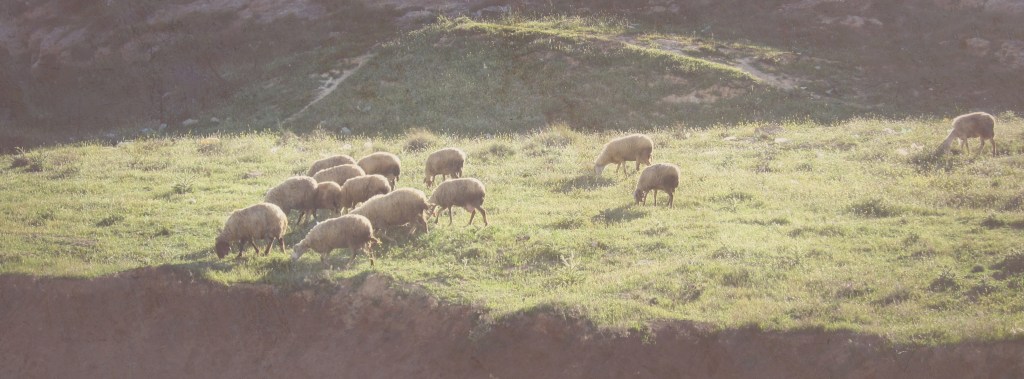
A shout rang out in the clear night air. “Shalom, shalom! Is anyone there?” I leaned over the parapet. Below, at our front door, I saw a bunch of ten or twelve shepherds clad in rough cloaks or thick sheepskins. One had a kid slung over his shoulders and another carried a tiny lamb in his arms. The leader lifted his torch and stared upward at me.
“Shalom!” he repeated.
“Shalom,” I replied, wondering what sort of errand they could possibly on in the middle of the night.
“Is there a newborn baby in this house?” He paused a moment, and then added quizzically, “A baby in a manger?”
A baby. In a manger. My face must have shown my astonishment, because the shepherd laughed, his voice echoing merrily from the stone walls of our home.
“Y-yes,” I stammered at last.
“May we see him?” he demanded eagerly. “We have a message. We have a message from some angels!”
Now my father was leaning over the parapet beside me. “What message?” he called.
“A message to us in David’s town,” the shepherd shouted back. “From heaven, shalom! Messiah is born! We have a son!”
My father and I stared at each other.
At last, I recovered my voice. “What did the angel name him, Abba?”
My father laughed, his face radiant with joy. “His name is Salvation.”
“I believe it,” I said.


 Elisabeth Adams
Leave a comment