This retelling of the Biblical account was inspired by the research of Dr. Stephen Pfann and Claire Pfann. They note that the Greek word kataluma, normally translated as “inn” in the nativity story, later appears in the Gospels as “upper room” or “guest room,” while the conventional inn in the story of the Good Samaritan is pundakeion in the original Greek.
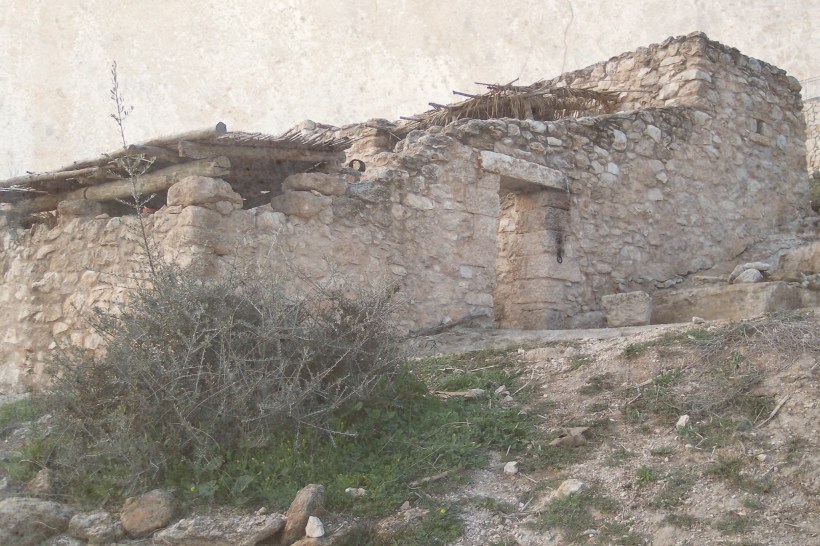
The sound of rain drumming on the roof grew louder and louder as I swiftly climbed the stairs and entered the large guest room which took up the entire upper story of our home. The floor was covered with rows of mats, some occupied by small, napping nieces and nephews. Several clay lamps set in wall niches relieved a little of the late afternoon gloom, while in the far corner of the room a small charcoal brazier fought unsuccessfully with the pervading cold and damp.
As my eyes adjusted to the darkness, I bent over the cradle of my newest nephew, baby Noam. To my surprise, his round brown eyes stared back at mine, and he let out a lusty wail for attention. I snatched him out of the cradle, but it was too late. Little Naomi, Yoav, Abigail, Tamar, and Shammai awoke. Within just a few minutes, they were laughing and running around the room. Their mothers – my older sisters – would be furious!
Then Aunt Deborah’s round, cheerful face appeared in the doorway. “Let me take the children, Hava,” she said to me. “You’ve had your hands full for days, getting ready for our arrival, and it’s time you had a rest.”
With a grateful smile, I kissed her cheek. As I descended the stairs, a wave of warm air laced with the aroma of garlic, simmering lentils, and baking bread rose up to meet me from the lower floor. To my right, the cooking area was crowded with chattering women: my sisters and aunts and cousins. Some were tasting broth, some slicing vegetables, some grinding barley into flour, some pouring out wine into pottery cups and mixing it with water. Like a queen, my mother presided over it all, while firelight etched the laugh lines in her face and touched the silver in her hair.
To my left, uncles and brothers-in-law and cousins lounged on low couches around a large brazier, the men talking, the boys listening with sparkling eyes. “Roman subjects, Roman taxes,” my father was saying. I frowned. I wanted to think of this time as an unexpected family holiday, not the result of some emperor’s command. So we were now a Roman province; so we had to register in our hometowns: at least that brought everyone I loved most to stay under the patriarchal roof. “The family inn,” my father likes to call it, but that’s just our way. When we travel, we stay with family. And home, real home for an Israelite – no matter how old – is in his father’s house.
Now only two were missing from the family circle. One was Yosi, my older brother, the only son in a large family of daughters. The other was Nathan. An orphaned distant cousin who had grown up in our house, he had come to regard my father as his own. It was only natural, then, that I’d recently been betrothed to him. My father was overjoyed to have his youngest child’s future settled so well, especially since at fifteen, I was well on my way to old-maidhood. During our betrothal year, Nathan had joined my brother in the rapidly growing new Jewish settlement of Galilee. There (unlike our changeless ancient hometown) he found plenty of work as a stonemason and carpenter. It was only three days’ journey to the north, but it might as well have been Spain for how far away it felt. Sending letters was only for the rich, or for those with connections to the Roman military, so I had no way of knowing when Nathan would come.
But I could get ready for his arrival. The upper room was already filled to bursting, but not the storeroom, a natural cave beneath the house which my father had enlarged by cutting into the hillside. Now that it was winter, a pen in the corner of our cave-room sheltered the lambs and kids from the cold and rain. Much of the spacious area, though, was filled with huge clay jars of wine, grain, and oil. Near these I piled a thick cushion of hay and spread a sheepskin over it to make a bed. Lying down to test its softness, I stared idly at the bunches of herbs and strings of dried figs dangling overhead and drank in the quiet. The bustling world upstairs seemed far away.
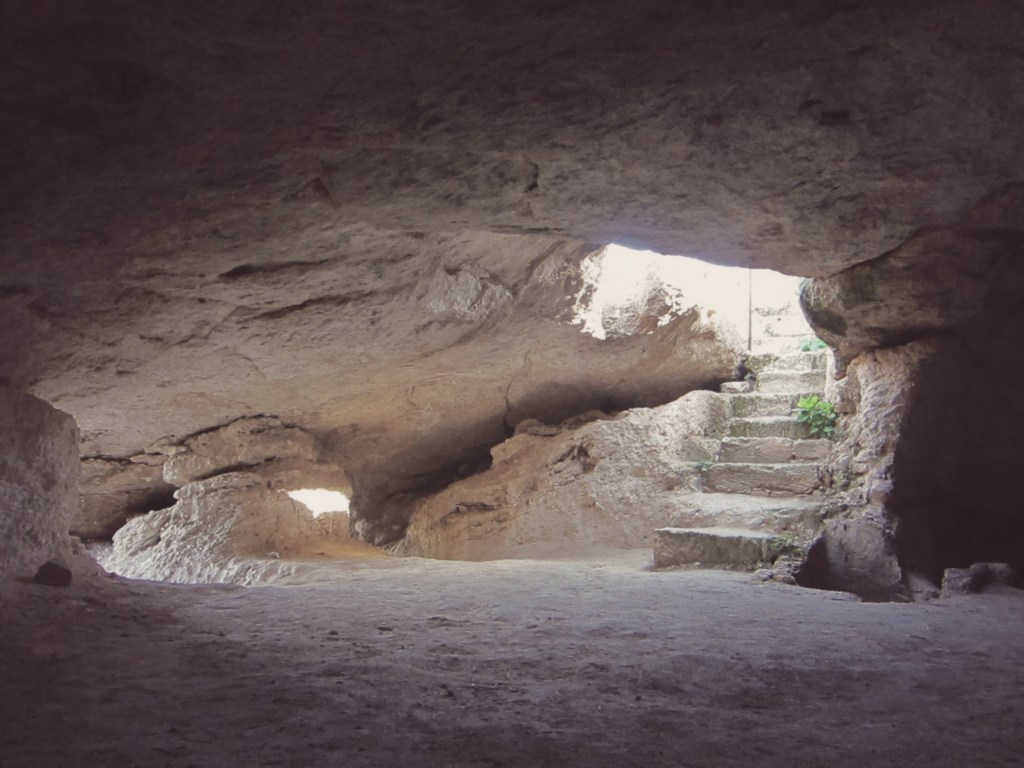
A breeze billowed the thick goat’s hair curtain over the original cave entrance, fitfully allowing sound to reach me inside the storeroom. The thrumming rain had died down to a few scattered drips and drops. I heard sheep baaing in the distance, then the rattling of a few stones, the rustle of approaching footsteps, and the low hum of voices somewhere outside.
“What?” I heard my father roar in surprise and anger. “Doesn’t he know that his failure is my failure?”
“But he didn’t do it!” It was a man’s voice, too quiet to be recognizable.
My father ignored him, adding, “For the rest of his life, he’ll be known as the man who couldn’t wait.”
The other voice persisted softly, “I tell you, he didn’t do it.”
There was a pause, and then my father groaned, “Why, oh why did we ever think that a Galilean girl would make a proper wife…”
“She’s innocent! I know her well, and I’m sure of it.”
Again there was a long pause. Finally, I heard a heavy sigh, and my father said, “Well, if I believe that, then I must I doubt my own son.”
My heart contracted. His son? My brother was in trouble?
“Sir,” the other voice said eagerly, “Your son is as honorable a man as Boaz was when he spread the protection of his name over Ruth.”
“Is he indeed?” my father said heavily. Then he added in a brisk tone, “Come inside and get warm. I must at least discuss the matter with the other men.” The voices were drawing nearer now, and my father lifted the curtain. A ray of weak sunlight shot through the gap as he entered my cave-refuge and dropped the flap behind him.
“Abba!” I said, and my father peered at me through the gloom
“Hava,” he began sharply, but stopped as the flap was lifted again. There, hair and clothing dripping, was Nathan. He lowered his head and shook like a dog, saying, “If I could just borrow a cloak, sir, I’ll wait outside with them.”
“I’ll get one!” I said, winning a surprised smile from Nathan. My father said nothing, only rested a heavy hand on my shoulder for a moment before I turned to get the sheepskin from the bed.
Thanking me, Nathan donned the heavy makeshift cloak and hurried back into the wavering daylight. I ached to go with him, to see my brother, but I was left alone with my father. Uncomfortably aware that I had been eavesdropping, I stood with head bowed as the silence deepened around me. When I risked a glance at my father’s face, I saw that his eyes were closed and his lips were moving soundlessly.
At last, shoulders slumped, he turned toward the ladder that led to our home.
“Abba,” I blurted, “Yosi is here… May I go out to him?” He did not turn, but I thought I saw him nod slightly.
Lifting the curtain, I saw that the rain had stopped. Above the red disk of the setting sun, the cloudless sky reddened innocently as if there had never been a storm. I rushed to the courtyard gate. There, beside a loaded donkey, stood my brother Yosi, mud splattered up to his knees. Leave it to the Romans to arrange a census during the rainy season, I thought wryly. The plains would be cubits deep in mud, and the roads in the hill country treacherously carved up by flash floods. No wonder Yosi looked so travel-stained.
But who was that on the donkey? A woman thickly swathed in sodden layers of clothing, whose body drooped heavily, as if each limb was filled with stone. With infinite care, Yosi lifted her off the donkey and set her gently on the ground, where he continued to support her with one strong arm. Turning to me, he said quietly, “This is Miryam.”
Though slightly taller than I, she was just my age. Her large dark eyes, glowing with some sort of excitement, were in curious contrast to the rest of her face, which was drawn with weariness and – was it pain? Now that she was standing I saw why: she was heavy with child.
My mind began racing. A child? I couldn’t believe this of my beloved brother. I knew he’d been betrothed at about the same time as Nathan and I, to a distant relative whom I’d never met, but…
Wait! My thoughts flicked back to the conversation I had overheard. The “Galilean girl” my brother was protecting was this girl, and the thing he “did not do” was father this child. Or did he? I studied his weary face, wondering if life in rough Galilee had really changed him so much. As if in answer to my doubts, Yosi smiled at me, his brown eyes warm and steady.
As I stood there irresolutely, I felt an arm around my shoulders, and met my Nathan’s pleading gaze. “Don’t you realize that I could easily take your brother’s place of influence in the family if he is discredited?” He took a deep breath, adding, “Why would I defend him if I believed him to be wrong?”
“And why,” asked my brother quietly, “would I remain betrothed to Miryam if I believed her to be unfaithful?”
I looked from one loved face to the other. Both were completely serious; both were completely…insane? What kind of paradox were they trying to get me to believe?
Unbidden, a picture came to mind: this Miryam waiting, her life hanging in the balance while Yosi made his decision. Betrothal, after all, was a contract so binding that if he refused to acknowledge the baby, she could be stoned as an adulteress.
There was another option, of course. Since some rabbis allowed a man to put away his wife for reasons as small as burning his food, Yosi could have divorced her quietly, saying only that he had changed his mind. Much easier than claiming someone else’s child and being marked for life as a man of weak character.
Instead, he had brought her home.
Hearing a slight moan, I looked up to see Miryam pressing a hand to her side. Evidently the journey had brought on early labor pains, and here she was, miles from her own family, and about to deliver a baby.
I forgot all my questions. “Yosi, why are you just standing there?” I scolded. “Can’t you see she needs help?”
Yosi was laughing at me now, but he whisked Miryam into his arms. “Is that better?” he asked teasingly.
Then he grew sober, adding, “I’d like to speak to my father before we go inside.”
My father. Now here was an obstacle indeed.
If Abba accepts Yosi, then so must we all, I thought. But how could he? At best he could only conclude that Yosi had made a foolhardy decision in defending this girl, forgetting his own family in his love for her: forgetting that in covering her shame, he involved us all.
Well, I would do what I could.
Inside, the men were engaged in a heated discussion. My uncle Micah’s patrician face was flushed with anger. My father’s face was equally flushed, but his eyes softened as I approached. “Abba,” I whispered in his ear, “Please, will you come talk to Yosi?” He looked directly into my eyes for a moment, and then nodded as if satisfied. Rising and excusing himself, he went quietly outside.

 Elisabeth Adams
Leave a comment