Skip to content

Elisabeth Adams

  • About
  • Blog
  • Reading
  • Writing
  • Editing
  • Contact
    • Instagram
  • sanctuary

    Autumn has arrived, and it is breathtakingly beautiful. The air is crystal-clear, and it smells so sweet to a city-dweller like me. I still get to bask in wide-open space and green. But here’s the thing: it’s cold. Or more accurately, it feels cold to me. Like the last time I was here in the fall, it’s taking me a long while to adjust to the change in climates. (Oh. And did I mention the days and days of much-needed rain?)

    But Friday and Saturday, I had a reprieve: a couple days of Indian summer. I guess you could call it a sanctuary in time.

    Happily, it was also Sukkot, yet another sanctuary in time: the one you might know as the feast of tabernacles, or booths. In Hebrew, a booth is a sukkah (plural: sukkot), and it recalls Israel’s trek through the wilderness, when God camped with them, living in the next tent over. So sukkah-dwelling reminds me that I’m a transient here on earth, that I have a home in heaven — and yet I’m a guest at God’s table today.

    Last year, I had no outside spot of my own to build one, so I went sukkah-chasing with my camera.  They sprout on balconies, in gardens, and over tables belonging to sidewalk cafes. At the end of the week, ten shekels and a slice of pizza bought me some sukkah-sitting time.

    This year I had wide-open space, and so (with the help of some friends), I built a sukkah. On Friday night and Saturday, it was my sanctuary. Its fabric walls broadcast candlelight like a Japanese lantern at dusk, and let in morning sunshine through every inch. At night, a bright, inquisitive moon kept peeking down through the hemlock branches that stood in for palm-fronds on its roof. It was perfect.

    But like all sukkahs, it came with an expiration date. Late Saturday afternoon, a wind blew up, my sukkah fell down, and it began to rain. Ironically, just then, a friend was on her way for tea in the open air. So we took our sense of sanctuary inside, and talked and sipped for two delightful hours.

    That was Saturday, but this is Monday. Sukkot ends in just a few minutes, my sukkah is just a pile of branches outside, and I woke up this morning, apparently, for the express purpose of feeling down — that (happily rare) inane emotion that scowls at sunshine and scarlet and gold leaves, cheating the beauty right out of a perfectly good day.

    But God-with-us is still with me; His invisible tabernacle is pitched over my head at this moment, and His moveable feast is chasing me tonight: sure goodness, sheer kindness, and everlasting life.

    It’s here! My sanctuary is here, and my refuge-in-time is now. And He has a name: Jesus, my Immanuel.

    He brought me to His banqueting house; His banner over me is love.

    I left this draft on my screen tonight while my sister took me to the next town over. There I saw three friends and four strangers who gather monthly, considering their humble surroundings a good reminder of those for whom they pray. There, in an unheated attic room, wrapped in a blanket with my chilly feet on a humble plywood floor — I found sanctuary. And oh, the love and like minds, the listening ears, and the presence of God.

    He said to me, “My grace is sufficient for you, for my power is made perfect in weakness.” Therefore I will boast all the more gladly of my weaknesses, so that the power of Christ may pitch a tabernacle over me.

    This slideshow requires JavaScript.

    Elisabeth

    October 8, 2012
    Writing Life
    1 comment on sanctuary
  • slow

    I’m making yogurt tonight.

    Or perhaps more accurately at the moment, it’s making itself. This afternoon I scalded a half gallon of whole milk, cooled it slightly,  and swirled in a little plain yogurt. The resulting mixture is now to be found in two clean jars, tightly capped, immersed in a pot of warm water, swathed in a couple thick towels — and slowly thickening, one hopes, into something very close to the two-liter jugs of rich, real yogurt I buy in Jerusalem. But I won’t know for sure until tomorrow morning.

    A lot of things are happening right now. Slow, quiet things that are developing even more imperceptibly than the yogurt on my kitchen counter.

    This week, I became rewoven into life at home by just a few more strands. I tried to acclimate my sun-warmed bones to almost-autumn weather. Will I manage it before it’s time to return to the Mediterranean? Hard to tell: it takes a lot of walks outside to reset my internal thermometer.

    This week, I turned a sermon into nearly nine pages of text, one keystroke at a time, and reshaped another chunk of someone else’s words into what someday may become a published book. I lived a few more days, and chose (sometimes falteringly, sometimes resoundingly) to trust God on each of them. I was surprised by how quickly I lost and had to regain that trust — and how much He could do in me, anyway.

    This week, I grew several friendships, both near and far, by just one or two (or five) more conversations. And I heard more about a friend’s unfolding miracle. It’s not my miracle, but it’s for me, nonetheless, because I’m one of those who dared to ask (not really expecting it would ever come). But from the sidelines I see him taking a risk, and her choosing to trust him, and both with their eyes, like children taking wobbly first steps, on their Abba-in-heaven. And I’m pretty sure that He is beaming with joy.

    How will it end? I don’t know. It’s too soon to tell.

    I keep smiling at the three babies in my home-congregation. With a little peekaboo added, that peculiarly intense baby-stare eventually melts into eye-twinkles, then half-smiles, then grins.

    Perhaps they’ll learn to know me; who knows? It takes time to win a child’s trust.

    How’s life right now? It’s quiet. It’s slow. And it’s very good.

    Elisabeth

    September 17, 2012
    Writing Life
    No comments on slow
  • pain

    One of the most practical things I do as a single woman — and even more importantly, as a disciple of Jesus — is to tell myself the truth. Because as convincing as they may seem, not every thought or feeling I have is actually factual.

    If they were all true, well, I’d be unattractive some days and beautiful on others. I’d love my loved ones one day, and ship them off to Peru the next. One week, God would be trustworthy — and the next, well, that’s when I’d need to hide in a bunker somewhere, just in case.

    Oh yes, our enemy knows how we tick. One of the cruelest lies I know is the one where everybody around you has it all together spiritually — the reason being that they were simply born that way.

    Not true.

    No one has it all together. And nobody is actually “born that way.” No, every bit of grace and greatness and just plain looking like Jesus — it all comes straight from Jesus. There just ain’t any other source.

    Now, here’s another grievous lie: I am alone in my pain.

    So not true! When Jesus sticks closer than a brother, never to leave or forsake me, that means He is stuck in every painful spot where I am stuck. In all my affliction, He is afflicted.

    But there’s more. There is, in fact, a not-so-secret club, the “fellowship of affliction.” My pain does not shut me out; on the contrary, it draws me into some of the sweetest camaraderie I will ever know.

    I know as singles, we can feel threatened by the unwisdom or unsympathy of married friends — or the poor or clumsy choices of single men or women. Considering the fact that we are one body of Christ, this is a tragic illusion. And I don’t use that word lightly. Divide and conquer, stir up distrust, pick off the weak and hurting ones on the edges of the flock: these are the tactics of an enemy.

    Let’s not succumb! Let’s lean in to the fellowship of the suffering and learn from one another. This week, for instance, I am praying in a special way about the lack of marriage in the church. Joining me are a host of friends, married and single alike, who have a heart for God’s glory and the growth of His kingdom. This is fellowship. This is bearing one another’s burdens. This softens my heart for the pain of others, as they take up the fight for mine.

    Let’s tell ourselves the truth. We are not alone!

    As Natasha Metzler writes in her new book, Pain Redeemed, “When I abandon the foolish idea that I’m the only one writhing in sorrow I get the privilege of watching and rejoicing in more victories than just my own.” She reminds me that whether it’s the pain of infertility, the loss of a child, the wounding of a marriage — or the lack of marriage — we have far more that unites us than divides.

    For all those who are in pain (are there any who are not?), I’d highly recommend Natasha’s book. Because yes, pain can be, and is redeemed.

    Elisabeth

    September 11, 2012
    Book Review
    4 comments on pain
  • green

    Reverse culture shock is a fleeting and fascinating thing. Just for a little while, I get to see my country from an outside perspective…just until my brain accepts the fact that I’ve arrived at the other normal.

    At first, I am taken by all sorts of random ordinary facts. Like eating perfect bananas, walking under tall trees, and seeing ridiculously quaint buildings under a pastel sky with clouds.  Single family homes …with yards. A real English-language library, for free. The extra dark far-from-city night with its extra bright stars. Over-enormous shopping centers, and dust-free cars. I find I miss hearing Hebrew, I need sun like I’m a solar panel — and after a long brown summer, I can’t stop exclaiming over the green. I see it and smell it and bask in the refreshment it brings to my spirit.

    Yes, I’m home for a wee while, and already I’ve hit five states and seen five of my long longed-for siblings. I’ve beachcombed and sight-seen, and subbed in at a greenmarket selling maple syrup. I’ve seen the maple farm, wrangled kittens, made challah and hummus and buttermilk biscuits, played Skipbo, and exchanged virtual conversations for real ones with many of the folks I love best in the world.

    Each morning I wake up one flight of stairs away from my grandma and know that it’s because God hears and answers prayer. Because He sees and He knows and He loves.

    This slideshow requires JavaScript.

    Elisabeth

    September 10, 2012
    Writing Life
    No comments on green
  • practice

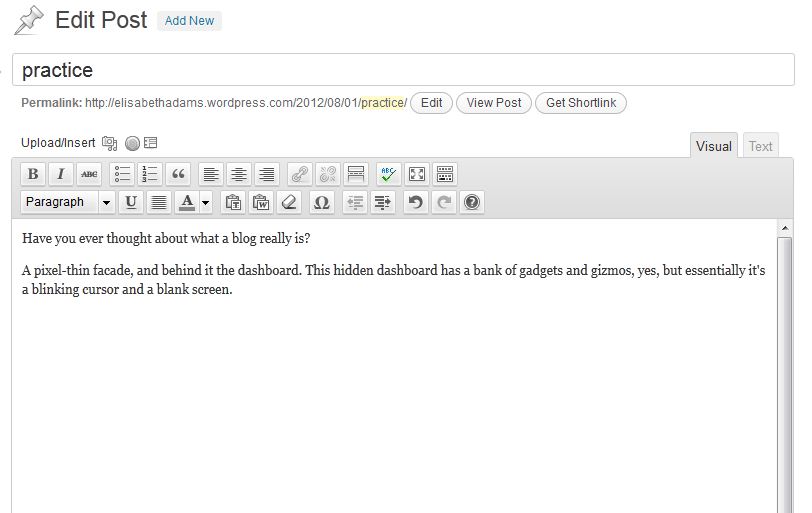
    Have you ever thought about what a blog really is?

    A pixel-thin facade, and behind it the dashboard. This hidden dashboard has a bank of gadgets and gizmos, yes, but essentially it’s a blinking cursor and a blank screen.

    A place to practice the adventure and discipline of writing. A place where I’m regularly surprised by the things I end up saying.

    If you could take a peek at the dashboard of my life right now, you’d see a whole bank of praying friends. They are there when I need them — and oh, how I need them! You’d see, too, the gadgets and gizmos I sometimes try to avoid the puzzlement of life. But in the end, it still comes down to me, the blinking cursor, and the blank screen.

    A place to practice the presence of God.

    Say what?

    Listen, some folks practice medicine, right? They set up shop, settle down, and do the stuff a doctor does, day in and day out, deepening and broadening and growing in the identity of a doctor.

    Some folks practice music. They sit down at a silent keyboard, take limp hands off their knees, and play. Hour after hour, note after chord after scale after crescendo. What first comes only out of stiff fingertip begins to flow from their hearts. They tell tale after tale, all to the glory of God.

    Some folks practice the words of Jesus, when He said “Be in Me at all times.” Their limp and silent hearts turn away from distractions, and begin to hear the ache within. And to tell that tale to the ears of their Heavenly Father. Their roots sink deep in the soil of who He is. He animates their once-stiff fingers to type and play and sing and shout out His glory.

    But the life is at the roots. It’s there on the hidden screen. Before there are words. And even if words never come.

    Sometimes, they don’t.

    If I had actually written all the posts I’ve begun composing in my head since the last time I was here, this blog would have been a busy place.

    But (ironically? providentially?) a bit of what I wrote about last time has now come true: certain change certainly did come knocking at my door. Not a change of relationship status, but change nonetheless, and my head is spinning with decisions and calculations and ramifications and regrets and anticipations…

    And hallelujah! I am forced to practice the presence of God. There’s nothing else to do but become a little child. Saying simply, “Daddy, I’m scared,” or “I’m sad right now” or “I really don’t know what step to take next.”

    I practice. He is present.

    All is well.

    Elisabeth

    August 1, 2012
    Writing Life
    1 comment on practice
  • engaged?

    No, not that kind of engaged.

    I’m talking about being fully alive, “fully engaged, and full of integrity.” The opposite of tuning out or checking out. And I’m convicted by a scenario from my childhood.

    You see, I spent hours and hours in a car, on the road, with my family. By the time I was eight, I’d already crossed the entire United States repeatedly, east to west. I’d seen the Grand Canyon, been amazed by snow in Yosemite, walked a cat on the salt flats of Utah, and lived in a tiny house by a creek in the Catskill mountains.

    Not all our travels were so varied. Eventually we graduated to a van, and — well, have you ever traveled with four sisters and three brothers? On a much-traveled track between home and summer camp? Sometimes we sang, sometimes we stopped for picnics. Sometimes we read aloud.  But much of the time, I used my superpower and tuned completely out, burying myself in a book, which meant escaping to another world. And that was okay.

    But something happened as I grew, and as I saw more brand new places. I stared out the window on my way to Nova Scotia, and I saw the tawny, lion-colored grass, the wild irises in the swamps, the wind-wizened apple trees. I cried over the approaching horizon of Israel from my tiny pane of glass. I scanned the high, green hills of Gilead from our bus, knowing I might never be in Jordan again. I didn’t miss the chocolate-dark dirt of fields in rural Sweden, or the rows of giant windmills turning lazily in the breeze. I was startled by Windsor Castle appearing postcard-like on the horizon, while simply riding down a highway in England.

    But I’m still tuning out. Oh yes, this life stage has gotten old. I know its contours, I’ve already experienced its joys, and now I’m tired of its sameness. Hope hurts too much. Bold faith is bewildering and exhausting. So I’ve got my nose pressed firmly in a book (figuratively and sometimes literally speaking), and I’m just marking time until I hear the van downshift, and feel it pull gently into the driveway — and I’ll open the door, and rush up the path, and I’ll be home at last. Oh, home.

    Can you see anything wrong with this picture?

    I can: there’s someone with me on this journey, and it’s Jesus. Tuning out the scenery means tuning Him out too.

    “Don’t let your longing slay the appetite of your living,” Jim Elliot wrote to Elisabeth, long before they were engaged. He was in Ecuador. She was at home, yearning to experience the adventure with him. Wise man, he said, “Live to the hilt every situation which you believe to be the will of God for you.”

    Stay awake. Look out the window. Enjoy the company. This journey may seem interminable, but it’s not. Change is certain; this season will end.  And there will be moments, strange to say, when these will be “the good old days.” When you will look back, perhaps, with regret over some opportunity open to you now, which will no longer be open to you in your longed-for future.

    God tells us to “remember the whole way” He led us — on a pleasure trip, the highlight of our lives? No, that trek through the wilderness: take note of that trail. Know its effect on your heart; see what it reveals about your Guide.

    Now is when I can learn what God is teaching me here. Now is when I can pray the specific prayers it will someday be His glory to answer.  Now is when I’ve got my seat right where I can watch His plan unfold.

    I am with Him, here, today.

    Elisabeth

    July 18, 2012
    Writing Life
    2 comments on engaged?
  • sister?

    Recently, I received this question from a male reader:

    “What’s a Guy to Do?” was very enlightening for me and I am thankful that it was posted. However, two quotes in the article seem to contradict each other and it’s making me confused. The following quote included in the article seems to suggest that men should not treat single women as sisters:

    I have watched single men treat single women as ‘safe’ because they think of her as a ‘sister.’ She’s not your sister. She has a heart, and quite often it weeps because you are treating her as a sister and not as a woman.

    Yet you also cite 1 Timothy 5:1-2, which says that we are to “encourage…older women as mothers, younger women as sisters, in all purity.” This passage seems to suggest that men should treat single women as sisters.

    Should I be treating single women as sisters or not? What is the difference between treating a single woman as a “sister” and treating a single woman as a “woman”?

    Good question!

    I think the distinction between treating a woman as “safe” because she’s a “sister,” and encouraging her as a sister has to do with the differences between a biological sister and a sister in the Lord. (In fact, I think Paul acknowledges this difference when he modifies his advice to treat women “as sisters” with the phrase “in all purity.”)

    Your biological sister has no desire for your romantic attention, so in that sense, she is safe: in other words, she’s immune to being led on by you. To treat a woman who is not your biological sister as “safe,” though, is unfair, because she may desire your romantic attention, and thus is not immune to being hurt by you.

    To “treat her like a woman,” then, is to acknowledge the fact that she is the opposite gender from you, that (regardless of your personal taste) she has romantic potential, and that she has desires and feelings that deserve your protection.

    To treat a woman as your sister in the Lord is to acknowledge the fact that separate from any romantic potential, you have an existing connection: you’re both children of God (and thus you have a compelling reason not to completely ignore her, any more than you ignore your biological sister).

    When you are attracted to a woman, I think there is a natural desire to treasure her feelings. It’s possible, when you are not attracted to a woman, to assume that she will not be attracted to you, and to act carelessly of her heart as a result. This may make her feel invisible, or of little value. I doubt this comes out of conscious unkindness, but it’s still worth considering. You may not know you are stepping on someone’s foot, but it hurts them just the same.

    Once you understand that a sister in the Lord won’t have the same feelings a biological sister does, you can be free to focus on all the other great aspects of sibling relationships besides building a one-on-one bond.

    But what should that brother/sister in Christ relationship actually look like?

    Ah, now that’s the really challenging question. I’d love to hear what others have learned from the Lord, but here’s what I’ve worked out so far:

    You are not in a relationship, but you are related to one another. You have a common spiritual heritage and destiny; you are teammates; you support one another in a non-possessive way, a way that focuses on strengthening the team/family as a whole.

    Perhaps this is easier for me to visualize, since I come from a large family. It’s true that siblings tend to form clusters or subgroups  according to birth order, life stage, and shared interests, but this is an ever-changing thing, not the permanent formation of exclusive relationships. Ideally, each keeps an eye out for all the other siblings, noticing who feels suffocated or excluded by too much or too little attention. They enjoy their shared interests, yes, but they value, preserve, and prioritize the larger family identity and bond.

    What do biological siblings share? Things like accountability and advocacy; empathy, prayer, and practical support in times of trouble; the joy of learning and growing as a group; and modeling godly, unselfish manhood and womanhood to one another.

    In short, they live out Jesus’ character — because that’s who really lives inside them, and they live as if each fellow disciple is an integral part of a unified whole — because that is, in fact, what they are: part of the body of Christ, and the family of God.

    Elisabeth

    July 5, 2012
    Boundless
    2 comments on sister?
  • quiet

    It’s a favorite pastime of mine in this very international city: guessing where a passerby is from.

    Sometimes a facial expression gives them away. Some cultures are very expressive, while others play their emotional cards very close to their chests. Then there’s body language. A tourist is often more alert and wide-eyed to an avalanche of new details, while a native tends to be focused only on where he’s going and what he’s got to accomplish. Then there’s the fashion element: for instance, American men tend to have a boxier, more casual silhouette, while European men tend towards the tailored with a touch of elegance. Stereotypes, certainly, but sometimes they work. Then there’s bone structure, complexion, and language.

    The other day, I helped serve a meal to a large group of tourists from…well, I didn’t know where. I saw faces that weren’t quite like any I’d seen before, and a language that sounded vaguely Scandinavian. As I was passing out plates of dessert, I asked one young man, “What’s your native language?”

    “Faroese,” he replied.

    “And where are you from?”

    “The Faroe Islands.”

    I smiled a bit sheepishly and said, “I have absolutely no idea where that is!”

    Turns out they’re found between Iceland and Denmark. Who knew?

    Geography was one of our great loves in school. We played games, drew maps, quizzed one another on capitols, and threw names like Bandar Seri Begawan around with great gusto. To run into a totally brand new place, embodied in some real live people, was exciting!

    I know geography isn’t everyone’s cup of tea, but I daresay that everyone has some subject they love to pursue. The Bible says it’s God’s glory to conceal a matter, and our glory to search it out. He created the astounding layers of complexity to discover in this world — and He designed the thrill of the chase.

    But knowledge and wisdom start and end with Him. And He’s the only one who understands absolutely everything.

    So sometimes it’s best to call a time out, and simply be. Quiet. In His presence.

    O LORD, my heart is not lifted up; my eyes are not raised too high;
    I do not occupy myself with things too great and too marvelous for me.
    But I have calmed and quieted my soul, like a weaned child with its mother.

    I think there’s a rhythm. Sometimes I’m chasing the truth, deep in discussion with others (this time on a subject that stumped even Solomon). Sometimes I’m worn out, and glad to be quiet against His shoulder — the One who is the Truth.

    I’ll be back tomorrow with another question and answer.

    But today I’m enjoying the quiet.

    Elisabeth

    July 4, 2012
    Boundless, Writing Life
    2 comments on quiet
  • invisible

    As a writer, I have to fight the feeling that each article I write must be pretty much the very last word I’ll ever have to say on that topic.

    This is a feeling, mind you. A vague, pushy feeling that doesn’t actually make sense when I bring it out into the light of day. Yes, I ought to choose a topic with an aspect I’ve actually lived, then add deep thought, Bible study, and research — not to mention a liberal dose of prayer. But there’s a delicate balance between honest research on one hand, and the fact that I’m a still-growing human being on the other.

    As a wise friend said after he previewed “What’s a Guy to Do?” the article will be a success if it simply begins a conversation.

    And so it seems to have done.

    One of the tricky things about writing an article is that it can appear to others to be my very last word on a subject. In reality, I can only spend a few weeks (or months) in the research and writing process. I have a word limit. And I have to choose a specific focus and audience that may not take in even the full scope of what I had to say at the time I submitted the article.

    In the case of “What’s a Guy to Do?” I could have written to both men and women — but the subject was too big and complex for 1200-1600 words.

    I could have written about how women can fight lust. After all, this is a human problem, not merely a male one. I hope someone can help you with that. But right now, it’s not me.

    I could have discussed the way a perfectly natural feminine desire to belong to someone can quickly translate into an attitude of possessiveness over a man she admires.

    I could have explained that lust and coveting are closely related, and appear to be equally serious in God’s sight. In the Bible, desire, lust and coveting can all be translations of a single Hebrew word for the fact that you view something as good and delightful. The moral implications lie in whether the desired object (or person) is yours.

    I could have written a list of things for a woman to do when she is tempted to be infatuated, or when she is allowing herself to be led on by a guy who is innocent of any such intention. She could:

    • Pray, honestly holding her desires before the Lord with open hands, allowing Him to change her heart as necessary.
    • Confront her own wishful thinking, faithfully telling herself the truth.
    • Refuse to jump to conclusions about her own feelings, the guy’s intentions, or God’s plan —  viewing her own warm feelings as a call to unselfishness and part of God’s deepening work in her heart, not entitlement; seeing what could be “signals” of romantic intentions as simple kindness until the man states otherwise; taking “signs” and coincidences as just coincidences, unless God clearly indicates otherwise.
    • View managing her emotions as part of the maturing process, and good practice for stewardship in other areas of her life.
    • Steer her imagination away from actions and desires that aren’t lawful to her today, just as if she was steering a car away from a cliff — which indeed she is doing!
    • Run confidently from storms of temptation, right into the only safe haven and truest safeguard for her heart — her Heavenly Father.

    I could have mentioned that this not-leading-a-girl-on goal is a learning process, that not even the most upstanding of men always get it right. I might have gently reminded men that barring direct communication, they simply don’t know what is going on in the hearts of the women around them (any more than the women know what is going on in theirs).

    I could have written in more detail to the men who think they are too ordinary to lead a girl on. I would have respectfully disagreed, citing real conversations I’ve had with real women who had their hearts hurt by perfectly “ordinary” men. I might have quoted one of the gentlemen whom I interviewed for my article, who said: “I have never had to worry about being extremely attractive to members of the opposite sex in my point of view” — just before he listed the ways he dealt with the women who were extremely attracted to his chivalrous, good-listener, supposedly unattractive self.

    At the same time, I could have empathized wholeheartedly with a heartache common to many singles: feeling invisible. It really hurts to be habitually overlooked. People with fascinating minds, kind hearts, and solid characters really do get passed up because they came in a plain package, and people with stereotypically beautiful faces and physiques really do get picked for their packaging instead.

    But beautiful people can be just as invisible as the plain.

    No, I’m serious. Do you want a person to be fixated on your face, with no real interest in what goes on inside your heart? Yet that is exactly what happens to many of the “beautiful” people. While they are popular, their true friends may be rare, elbowed aside by those who simply want to bask in reflected glory, and to take.

    That’s why I keep talking about God’s kingdom way. We have real desires, wants that wrack our hearts and minds. But let the world run after what it can get and gain and take. Meanwhile, we can afford to offer unbiased kindness, and to be considerate about what behavior might trip others up — because God is at work on our needs, because He knows our hearts, because He is the God who sees —

    Even “invisible” me.

    Elisabeth

    June 25, 2012
    Boundless, Writing Life
    2 comments on invisible
  • What’s a Guy to Do?

    This article began with a quest for more guy-friendly topics. I made a simple request for ideas, and one of my male friends replied with a very thought-provoking question.

    Little did I know it was to take me way outside my writing comfort zone, spark a brainstorming session with 15 folks in five different countries, provide the catalyst for deepening friendships, spark a brand new blog, convict me about my own relationships, and leave me reluctantly editing out far more fabulous quotes than could ever fit in one place.

    I consoled myself by thinking I’d share some of their thoughts here on my blog. And (like the article itself) many of my bonus points are good for either gender. In a nutshell:

    The security of an emotionally close relationship is tempting, but premature before you’re pursuing marriage.

    Choose your confidants wisely. Find someone to give you a reality check, not feed your infatuation.

    Nobody likes empty flirting or having games played with their heart. Nobody likes a cold shoulder or a slow fade. So if someone is clearly interested in you, give a straightforward Yes or No.

    It’s a delicate balance, I know. Over-kindness and over-coldness are equally off track. Selfish rashness and selfish caution: both are outside the kingdom realm.

    Believers in Jesus, whether we marry each other or not, are on parallel tracks toward a common goal. This is a lifelong closeness and commitment: not to one another, but to Him.  As C. S. Lewis describes in The Four Loves, we stand — not eye to eye, like lovers — but shoulder to shoulder with eyes on the same goal. And with eyes (and heart) on that goal, we’ll be steering very well.

    “What’s a Guy to Do?” and “What’s a Girl to Do?” have a premise in common:

    Sometimes we don’t realize we have the power to hurt others, but as mature men and women, we need to recognize this and plan accordingly.

    Suzanne Hadley Gosselin has already written well about the mixed messages that are sometimes sent in mixed-gender friendships. Sometimes it’s the girl’s fault, sometimes it’s the guy’s — and sometimes it’s a joint effort. But today I’m talking about what men can do to keep from leading women on.

    And honestly? It’s not impossible to get it right.

    Suzanne says:

    I have interacted with guys who are genuine and friendly without making me wonder if they want me to have their children. Like a good dance partner, the guy gently eases me to a place where I understand he considers me a friend only. We may engage in a meaningful friendship, but he does not give false signals by inviting me to dinner, emailing me daily or initiating extended time together. While these actions are fine if the guy is interested, they are misleading if he’s not.

    Not sure how to keep from leading girls on? Here are a few things a guy can do.

    Elisabeth

    June 6, 2012
    Boundless
    2 comments on What’s a Guy to Do?
Previous Page
1 … 5 6 7 8 9 … 16
Next Page

Get my posts in your inbox.

© 2023 Elisabeth Adams · All Rights Reserved

Create a website or blog at WordPress.com


Loading Comments...
 

    • Subscribe Subscribed
      • Elisabeth Adams
      • Join 84 other subscribers
      • Already have a WordPress.com account? Log in now.
      • Elisabeth Adams
      • Subscribe Subscribed
      • Sign up
      • Log in
      • Report this content
      • View site in Reader
      • Manage subscriptions
      • Collapse this bar