Imagine that you’ve just lost your best friend in the whole world.
A couple days later, you drag yourself out of bed ’cause you’ve got to make a hike. You pull on your sandals, sling a bag and a water bottle over your shoulder, and meet your buddy at the usual place.
Quickly, you two leave the crowded city behind you, appreciating the silence after a hectic holiday weekend — even if it is the silence of the graveyards that are always kept outside city limits. You steer well around the burial cave openings and find the dusty red dirt path that winds westward.
Heads bent low over the grief and confusion you’re discussing together, the wildflowers underfoot escape your notice. Gradually, however, you become aware of footsteps on the path behind you. It’s just another traveler — headed the same way you are. You exchange greetings,and move over a bit to let him join you on the path, but the tide of your interrupted conversation immediately sucks you back in.
“What do you think about the stuff that happened in the city this weekend?” you ask.
“What things?” he says.
Wondering what rock he climbed out from under, you and your friend rush to fill him in on the tragedy.
That’s when the whole tide of the conversation changes, and you’re swept away by the most dizzying Bible study you’ve ever heard. You listen with all your heart, but something’s nagging at you. There’s something you should be noticing, but you can’t figure out what it is.
You barely notice the rest of the trip, but when you arrive at the village you’ve been aiming for, you are glad to sit down. Naturally, you invite your new friend to join you at the table, where a basket of flatbread awaits you. You ask him to do the blessing, and in one intensely familiar moment, he grasps a round crisp loaf, snaps it in two, and raises the pieces in the air.
Just as you recognize your best friend in the world — alive?! — he’s gone.
Once the shock clears from your mind, you smack yourself on the forehead. That’s what your burning heart had been saying: “Hey! I’m with Jesus.”
After that, there’s only one thing to do: return to Jerusalem and tell what happened!
 I’ve loved that story for a long time. Back in 2009, I wrote an article that referenced the Emmaus road as a metaphor for seeking and finding God’s will for my life. My editor asked if I’d actually been to Emmaus, and I was immediately smitten with a desire to go. However, the years ticked by, and I never actually made it there.
Until last Sunday.
I woke early, packed some water, matza, some chocolate, and the thinnest copy of the Bible I could find, and slung a red backpack over my shoulder. My two friends carried more snacks, and I had a couple home-printed maps, because the route — so simple two thousand years ago — has acquired a great deal more confusion since then. Try not one or two, but four candidates for Emmaus.
See what I mean?
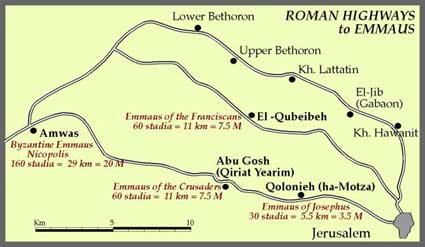 (I borrowed this file, by the way. Let me know if you know the original author).
Happily for my feet, the closest candidate also had the oldest literary evidence.
First stop for us was the Old City. Jaffa Gate: once the site of Herod’s palace, which was probably inherited by Pilate. David’s Street: now a narrow, crowded and colorful bazaar, which once led to the outskirts of the city, and an abandoned quarry turned garden, execution site and cemetery. Now that quarry is the time-warped Church of the Holy Sepulcher, where the small early-morning crowds had come to listen to a liturgy that sounded like it was straight from the Old Testament period. Unaccompanied men’s voices rose in the high stone space, a song-chant in unison, exotic harmony, and then in unison again.
Then we were off, and out Jaffa Gate, which is named for the city it leads to — which means that we were headed west. It was a grey morning, for all the world as if it were about to rain. Unfortunately, in this climate, at this time of year, it was much more likely signaling a fog-like dust storm. Resigning myself to low visibility, I continued on Jaffa Street, which leads through the heart of the new portion of Jerusalem, and to its northern entrance. The light rail train has turned it into a quiet, almost pedestrian street, except when its old world clang-clang signals the train’s arrival.
We arrived at the western entrance to Jerusalem, where a cowboy-hatted man was busking outside the Central Bus Station. Crossing the Bridge of Chords, we turned turned north towards the industrial zone. We passed shops and a commercial bakery (closed, surely, since it was Passover week when only unleavened bread is eaten), and found the valley we were seeking. How to get down into it; now that was another matter. A fenced-in building supplies area blocked our way in one direction; in another, it was a women’s hospital.
Rain (rain!) began polka-dotting the pavement. An unexpected blessing so late in the spring, it was just enough to make everything clear and sparkling — and calm my concerns about possible heat exhaustion. We stopped to ask an elderly gentleman for directions and lingered, chatting, in the brief shower. (Only in Jerusalem!) Finally, we found an access road to the gigantic new cemetery going up on multiple levels on one side of our valley, and down we went to its bottom.

Here a red, pebbly path led us west again. Gorgeous wooded slopes rose to our left; wet wild roses sparkled in the returning sunshine. We found ripening almonds (bitter: we tried them), burial caves from the first century, and a cave that had clearly been used for some kind of bonfire-picnic. When the outskirts of our Emmaus-village came into view, we sat down on a fallen log and read the Bible story.
And it was beautiful.
I could talk about the odd smells we encountered in the city on our way (well, worse than odd). I could say that we navigated past a tidy little dump when entering the valley…and that our return path through the brush in the very bottom of the valley was made much easier by walking along an enormous sewer pipe. I could tell you about the Roman cistern we found — and the Roman road that remained (maddeningly!) elusive.
It was almost nothing like I expected: I dreamed a contemplative hike — a pilgrimage, really. Instead it was an Adventure. Typical for the God of surprises! And yet it was just right, because the thing that really captures my heart about the Emmaus story is the fact that Jesus shows up — just when we least expect Him.
And oh, He really does! I remember that my heart burned with His presence once, as I stood in the very ordinary conference room of a hotel in Galilee, talking with my future professor. The fiction tale-in-progress I was discussing with him then has never seen the light of day, but that meeting would eventually lead to the writing and editing I do today.
Jesus was clearly with me like that, too, before I did one of the bravest things I’ve ever had to do. He didn’t shove me from behind. He beckoned from a place where He already was, waiting for me.
Do you have the kind of friend who could convince you to do most anything, just because you love their company so much? That’s what Emmaus is all about for me.
We’re going there, Jesus — really?
[Pause while I gulp, take a very firm hold on my hat, and prepare for a roller-coaster ride].
Oh, it’s with You?
Then let’s go.


 Elisabeth Adams